Description
Slender, silvery freshwater fish, the only species of the genus Pelecus (Sichling or Ziege in German). It lives in the slow stretches of large rivers, in estuaries and in lowland lakes of the Baltic, Black Sea, Caspian and Aral basins. In Austria it is a rare fish tied to the Danube and Lake Neusiedl.
How to identify it
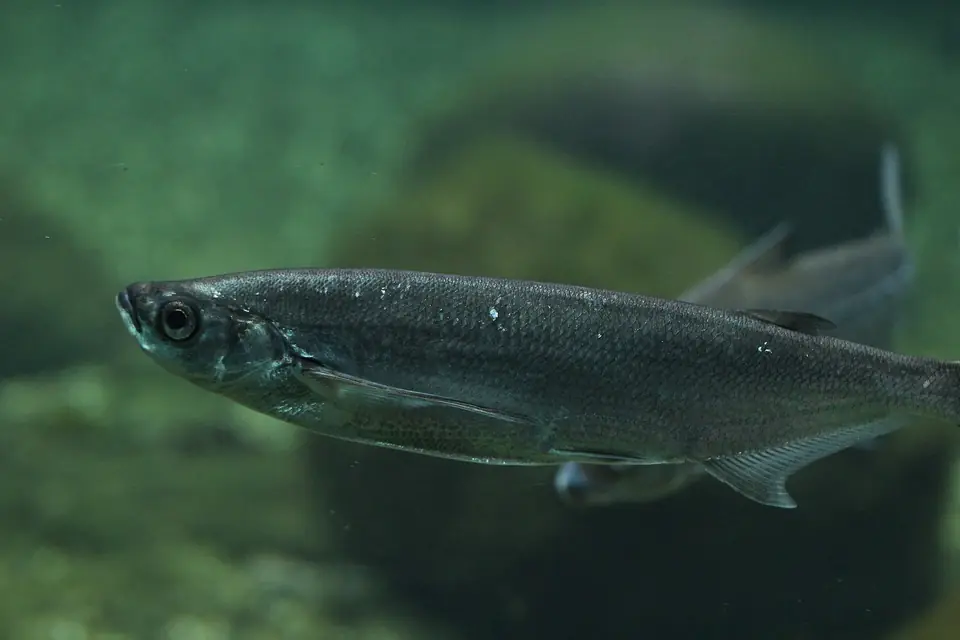
It is distinguished from other cyprinids by its almost straight back, sharp keeled belly and strongly upturned mouth. The wavy lateral line, low on the flank, and the all-silver livery with almost colourless fins complete the picture. It recalls a shad more than a common cyprinid.
Appearance
Elongated, low body, laterally compressed, with a straight back and a belly forming a true blade. Upturned mouth with a steep lower jaw; long pectoral fins and a dorsal fin set above the anal. Pale, silvery colour, with almost transparent fins.
Habitat and habits
Frequents slow-flowing stretches of large rivers, estuaries and shallow lowland lakes; some populations live permanently in rivers, others in brackish waters. It swims in shoals, closer to the bottom by day and towards the surface at night. In spring it ascends rivers to spawn in open water.
Where it lives
Native to the Baltic, Black Sea, Caspian and Aral basins, from the Oder to the Volga and the Urals. In Austria it occupies the slow stretches of the Danube and Lake Neusiedl. It is considered native, not invasive.
Conservation status
IUCN: least concern (LC). Austrian Red List: near threatened (NT).
Can be confused with
Bleak or other silvery cyprinids: Pelecus is recognised by its blade-like belly, straight back and strongly upturned mouth.
There's more in the app
This species' bite index, recommended baits and methods, and the rules of the day for every water. Offline too.
Soon on Android and iPhone