Bighead
Hypophthalmichthys nobilis
Description
Introduced Asian species that feeds by filtering plankton.
How to identify it
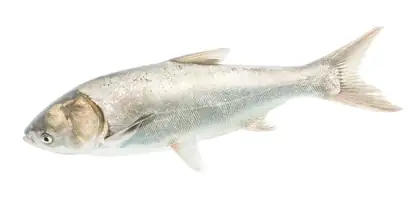
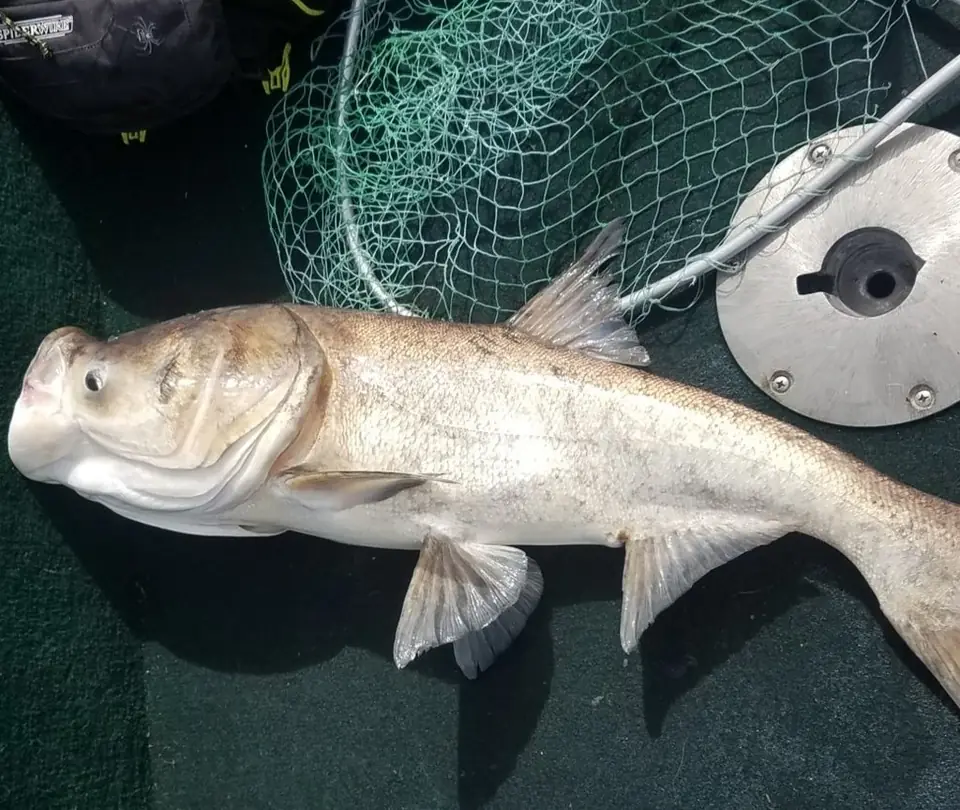
Enormous head, low-set eyes, upturned mouth, no barbels, dark blotches on the flanks.
Appearance
The most obvious feature is the disproportionate, scaleless head, with a very wide mouth and low-set eyes. The body is grey-silver, darker on the back, with a marbling of irregular dark spots on back and flanks. These spots and the bigger head are what set it apart from the tolstolobik bílý, which is a uniform silver. It is not confused with the common carp: it has no barbels or long dorsal fin, and the mouth points upwards.
Habitat and habits
Native to the large rivers and floodplains of East Asia, in Europe it lives mainly in ponds, lakes and reservoirs where it is stocked. It filters plankton like its silver relative, but retains larger particles and eats a greater share of zooplankton. It moves in groups in open water and often feeds near the surface, especially in warm water. Unlike the tolstolobik bílý, it does not jump when frightened: a good clue when you are watching big fish moving at the surface.
There's more in the app
This species' bite index, recommended baits and methods, and the rules of the day for every water. Offline too.
Soon on Android and iPhone