Description
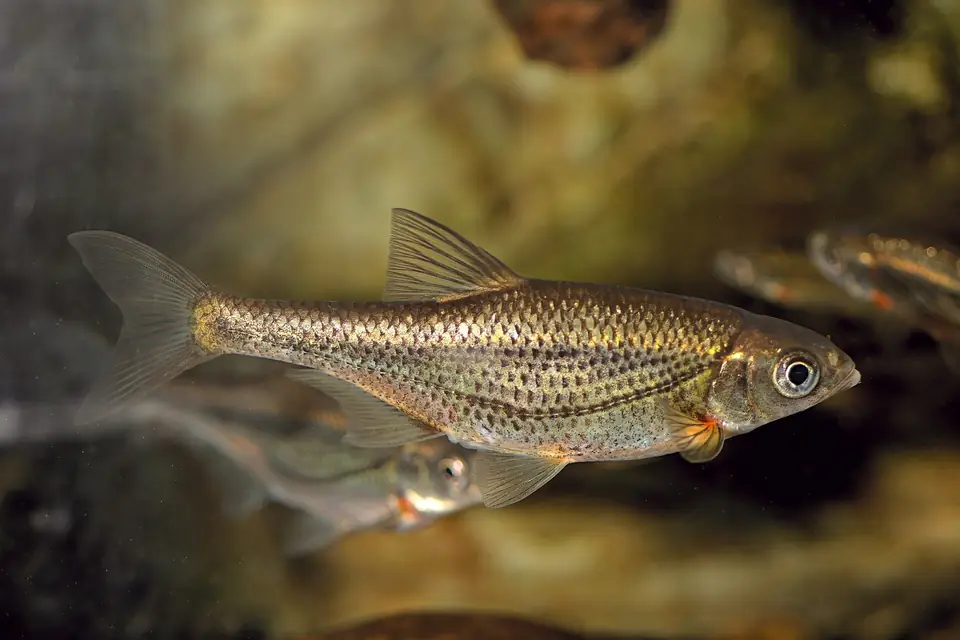
Small cyprinid of clear, well-oxygenated running waters, known in German as Schneider (also Schusslaube). In Austria it lives in streams and smaller rivers of valley floors and hill country; it is a good indicator of clean water and gravel beds.
How to identify it
Recognised by the lateral line that dips sharply towards the belly and by the broad dark band running from head to tail, with a terminal mouth. The pelvic fins have a reddish base; the anterior scales of the lateral line bear two black spots.
Appearance
Slender, slightly compressed body, silvery with a grey-green back. The dark lateral band is the most conspicuous feature. Long anal fin, with about 13-18 soft rays. Usual length 9-10 cm. Sexual dimorphism barely evident.
Habitat and habits
Prefers fast, clear, oxygen-rich watercourses with a bed of gravel, stones or sand. It stays in open water and in shoals, near the bottom or in mid-water. It also occurs in rivers with weaker current. Spawns in small groups on gravel beds in current.
Where it lives
Central and western Europe, in the basins draining into the North Sea, the Baltic and the Bay of Biscay, from the Loire to the upper Volga; in the Mediterranean only in the Rhône and a few small coastal rivers. It is present in the Austrian Danube basin. Native species.
Conservation status
IUCN: least concern (LC). Austrian Red List: LC. Not an invasive alien species of Union concern.
Can be confused with
Bleak or other small silvery cyprinids (Alburnus alburnus): the schneider has a dark lateral band and a strongly downward-curved lateral line, and a terminal mouth.
There's more in the app
This species' bite index, recommended baits and methods, and the rules of the day for every water. Offline too.
Soon on Android and iPhone