Description
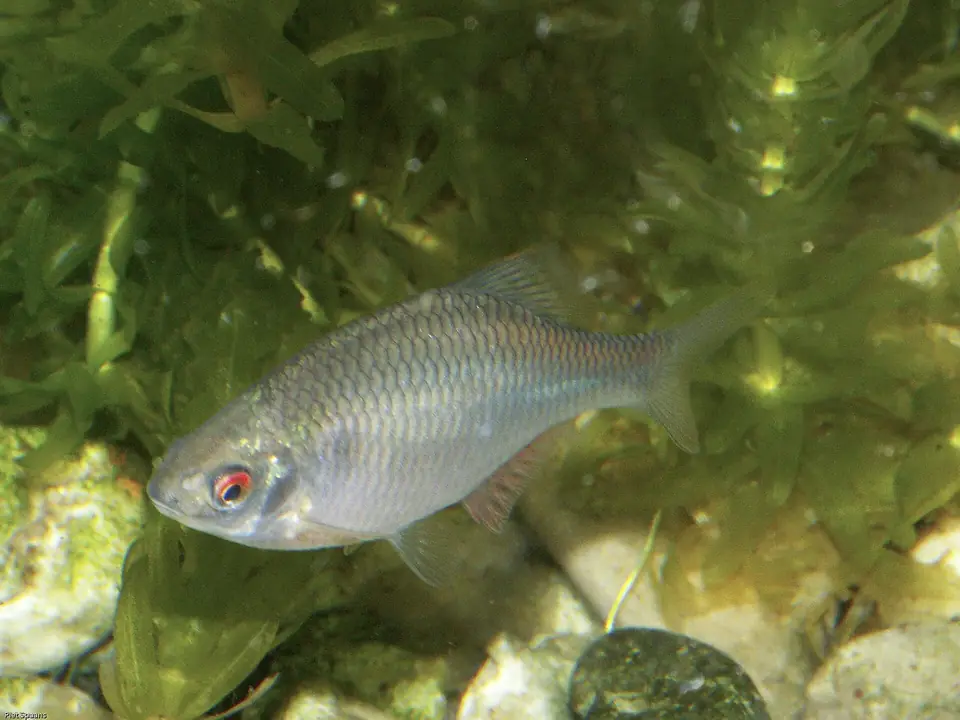
Small deep-bodied cyprinid, Bitterling in German, known for laying its eggs inside large freshwater bivalves. In Austria it lives in slow, vegetation-rich lowland waters and depends on the presence of molluscs such as Unio and Anodonta. It was Fish of the Year in Austria in 2008.
How to identify it
Deep, strongly compressed body, small, almost terminal mouth, very short lateral line and a bright blue-green stripe running from the start of the anal fin to the tail. From similar small cyprinids it is told apart precisely by the stripe and the incomplete lateral line.
Appearance
Grey-green back, silvery flanks and a blue-green stripe on the caudal peduncle. At spawning the male turns reddish on throat, chest and belly and has blue spots behind the operculum. The female develops a long ovipositor of 5–6 cm.
Habitat and habits
Flat, still or slow-flowing waters, with sandy or muddy bottoms and vegetation: oxbows, lower river reaches, ponds, shores of some lakes. It is present only where large bivalves live. It lives in small shoals.
Where it lives
Native in Europe from the Rhône to the Neva basin and the Caspian. In Austria it is present north of the Alps in lowland waters; it is expanding northwards with warming. It is not invasive.
Conservation status
IUCN: least concern (LC). Austrian Red List: vulnerable (VU). Habitats Directive: Annex II.
Can be confused with
Other small cyprinids of slow waters: the bitterling has a deep body and a blue-green stripe on the peduncle, and no barbels.
There's more in the app
This species' bite index, recommended baits and methods, and the rules of the day for every water. Offline too.
Soon on Android and iPhone