Description
Small Asian cyprinid, Blaubandbärbling in German, which reached Europe in the 1960s with fish imports for aquaculture. In Austria it has been present since 1982 and has bred massively in Lake Neusiedl. It is a worrying invader because it competes with native fish and carries a dangerous parasite.
How to identify it
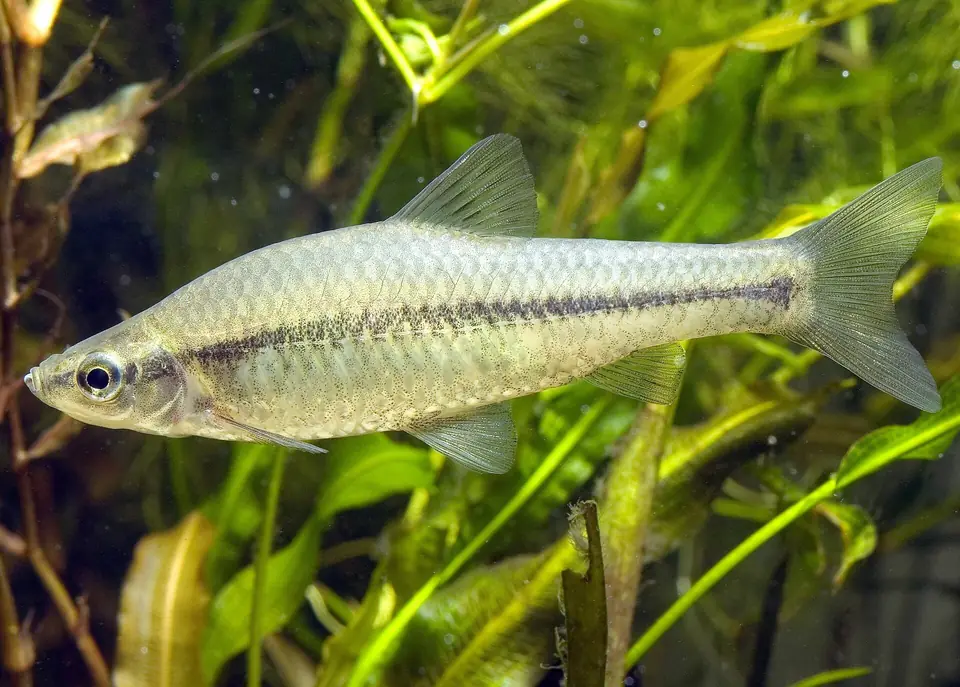
Upturned mouth, slender body tapering at the ends, dark half-moon spot on the rear edge of each scale and a dark blue band from the operculum to the tail. When young it can resemble the bleak or the minnow, but the band and the marked scales distinguish it.
Appearance
Torpedo-shaped body, up to about 9 cm long. Upturned mouth and dark lateral band; in spawning males the tones change. Unlike many cyprinids, males are on average larger than females.
Habitat and habits
Highly adaptable: ponds, lakes, canals and large rivers such as the Danube. Prefers still waters rich in vegetation and nutrients and avoids strong currents. It lives in shoals in shallow and shoreline areas.
Where it lives
Native to East Asia (Yangtze, Amur). Introduced to Romania in the 1960s, to Hungary in 1970 and to Austria in 1982, now widespread across Europe. It is an invasive alien species.
Conservation status
IUCN: least concern (LC). Austrian Red List: not evaluated (NE, exotic species). Invasive alien species of Union concern (EU Reg. 1143/2014).
Can be confused with
Bleak, minnow and other small cyprinids: the topmouth gudgeon has an upturned mouth, a blue band and scales with a half-moon spot.
There's more in the app
This species' bite index, recommended baits and methods, and the rules of the day for every water. Offline too.
Soon on Android and iPhone