Description
Small gregarious cyprinid of cool, well-oxygenated flowing waters, typical of the Rhine, Rhône and Danube. In Austria the German name Strömer (or Rißling) denotes the Danube subspecies T. s. agassizii; it is rare and threatened.
How to identify it
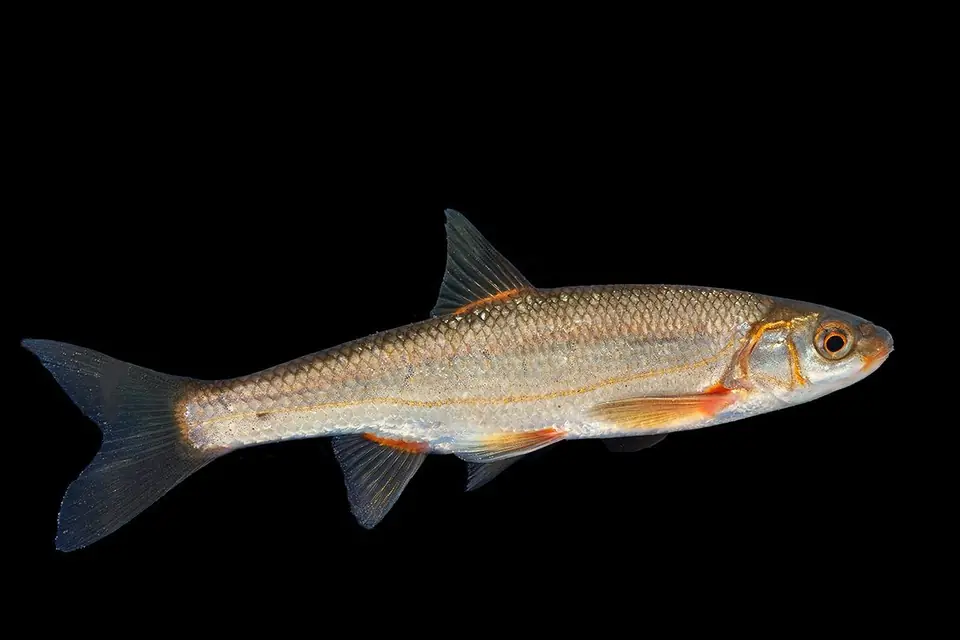
Slightly inferior mouth with a long gape, elongated fusiform body, orange lateral line and a dark band above it. At spawning the males show a dark band with violet reflections on the flanks.
Appearance
Elongated, slightly compressed body, grey-brown back with bluish reflections, silvery flanks, white belly. The snout is blunt. In the breeding season the males show a black band with violet reflections.
Habitat and habits
Lives in shoals in cool, well-oxygenated flowing waters, in rivers and large tributaries of the Danube, avoiding the warmer lowland stretches. It stays mid-water and in deeper water. Spawns in spring on fine gravel in fast current.
Where it lives
Europe: Rhône, Var, upper Rhine, Danube basin as far as the Carpathians and the Tisza area, Soča/Isonzo; up to about 850 m. In Austria it is native but rare; still good numbers in the Mur river near Graz.
Conservation status
IUCN: Least concern (LC). Austrian Red List: endangered (EN). Habitats Directive: Annex II. Not invasive.
Can be confused with
Chub (Squalius cephalus) and other leuciscids: the Souffia is smaller, with an orange lateral line and dark band above, and an inferior mouth.
There's more in the app
This species' bite index, recommended baits and methods, and the rules of the day for every water. Offline too.
Soon on Android and iPhone