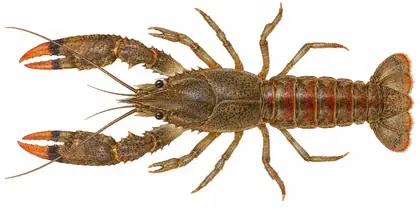
Native freshwater crayfish
Astacidae
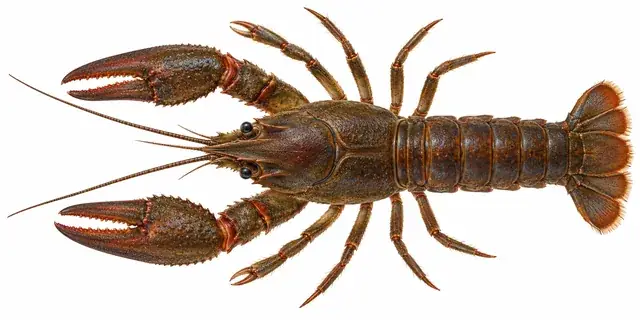
Barbel illustration
Description
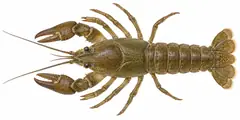
Decapod crustaceans that in central Europe and the Alps include three native species: the noble crayfish (Astacus astacus), the white-clawed crayfish (Austropotamobius pallipes) and the stone crayfish (Austropotamobius torrentium). All are threatened and protected; their decline is mainly due to crayfish plague, a disease caused by Aphanomyces astaci and carried by introduced North American species.
How to identify it
The three native crayfish have an olive-brown body without conspicuous colours. In the noble crayfish the underside and the joints of the claws are red; in the white-clawed and stone crayfish the underside of the claws is pale, whitish or beige. The noble crayfish is the largest, the stone crayfish the smallest. Unlike the invasive North American crayfish, they lack orange spots or pale patches at the joint of the claws; however, precise identification requires an expert.
Appearance
Cylindrical body with a sturdy carapace, two large claws (stronger in males) and a segmented abdomen ending in the tail fan; in females the abdomen is wider. The stone crayfish has a smooth, triangular rostrum without spines. Like all crustaceans, they grow by successive moults.
Habitat and habits
The noble crayfish lives in unpolluted streams, rivers and lakes with a soft bottom and plenty of hiding places, and avoids muddy waters. The white-clawed crayfish inhabits rivers and brooks and is sometimes also found in still waters; the stone crayfish prefers cold, fast-flowing streams but also lives in rivers and lakes. They dig burrows in the banks and hide under stones and roots; they are active at night and sensitive to pollution.
Where it lives
The noble crayfish is found from France to central Europe and the Balkans, north to Scandinavia. A. pallipes ranges from the eastern Balkan peninsula to Spain, as far as Great Britain. A. torrentium is centred on the Danube basin, also occurring in the Rhine and Elbe basins, and is also found in Italy.
Conservation status
IUCN: noble crayfish vulnerable (VU), A. pallipes endangered (EN), A. torrentium least concern (LC) in the most recent assessment, although it is considered one of the most threatened species in Europe. Habitats Directive: Annex V for the noble crayfish; Annexes II and V for A. pallipes and A. torrentium. Bern Convention: noble crayfish and stone crayfish protected.
Can be confused with
Invasive alien crayfish (Faxonius limosus, Pacifastacus leniusculus, Procambarus clarkii and others), which are carriers of crayfish plague.
Related species and forms
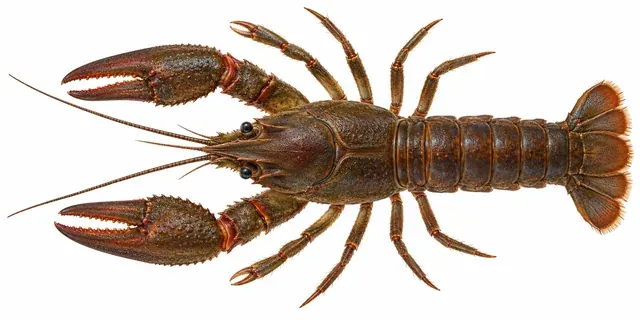
Noble crayfish
Astacus astacus
It is the largest native freshwater crayfish of Europe.
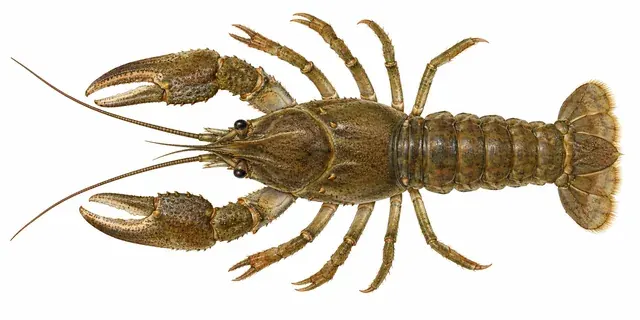
Atlantic Stream Crayfish
Austropotamobius pallipes
Small freshwater crayfish of western and southern Europe.
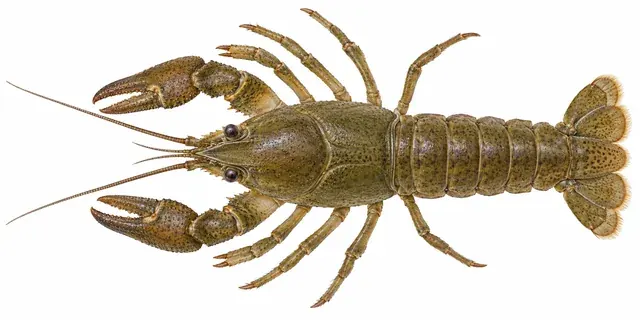
Stone Crayfish
Austropotamobius torrentium
It is the smallest European freshwater crayfish, called Steinkrebs or Bachkrebs in German.
There's more in the app
This species' bite index, recommended baits and methods, and the rules of the day for every water. Offline too.
Soon on Android and iPhone